
Fabric of Betrayal
In a world ruled by tyranny and injustice, Patrick and Mary McCarthy struggle to survive, to love, and to claim the futures they deserve.
I write historical fiction exploring the untold stories that shaped early Australia.

-

Acknowledgements
Special thanks to historians, archivists, and family who supported this project, including Ian Martin (Regimental Museum), Terri Adams OAM, Catherine Scally, Dr Veny Armmano and mentoring from Dr Mark MacLeod..
Fabric of Betrayal
A story of resilience, betrayal and courage inspired by an ancestral past.
About J. S. Best

Author of Fabric of Betrayal
J.S. Best is an Australian writer who crafts vivid worlds where power clashes, a sense of belonging is hard won, and resilience drives the story forward. Fabric of Betrayal is her debut novel. Tracing her family history from Ireland to the early convict settlements of Van Diemen’s Land, she gives voice to lives that were silenced or erased from the record.
Her writing is grounded in extensive historical research and shaped by a diverse management career spanning multinational organisations and board roles. She holds an MBA from the University of the Sunshine Coast (Dean’s Commendation), and her articles have appeared in newspapers, lifestyle, and professional trade magazines. An enthusiastic windsurfer, she calls the Sunshine Coast home.

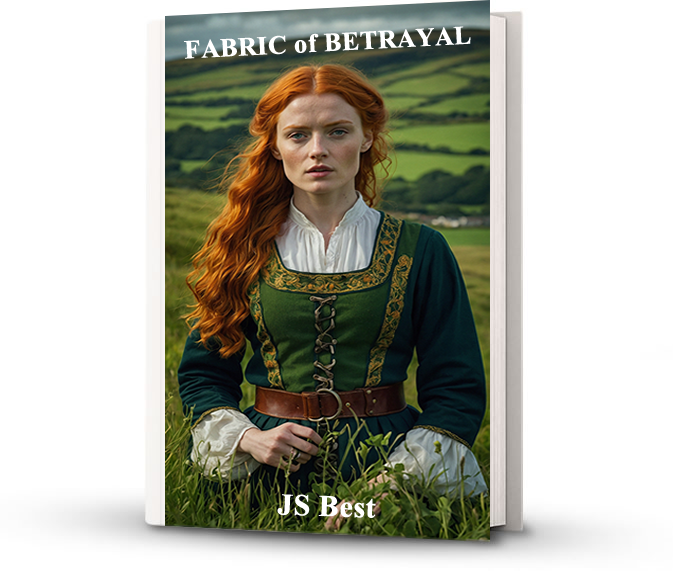
1795, County Cork, Ireland. Under English rule, Protestants thrive while Catholics and women are oppressed. Mary McCarthy and her son Patrick live in poverty, but Mary is determined to change their fate. She launches a daring lace-making business, secretly partnering with a handsome French merchant while concealing her earnings from her drunken husband.
Jealousy and betrayal strike when the merchant’s lover frames Mary for smuggling. Arrested and imprisoned, Mary faces a desperate fight for freedom as corruption and deceit entangle her family. Retried and found guilty of theft, she is sentenced to transportation to New South Wales.
On board the convict ship Britannia, Mary reconnects with her psychic aunt, who foretells that Mary will become a healer in the new land. Meanwhile, the French merchant flees to Versailles, only to discover the betrayal that destroyed his business, while his vengeful lover enlists in Napoleon’s army.
Patrick joins the Scottish 25th Regiment of Foot, fighting in Egypt during the Napoleonic wars. There, he confronts his mother’s nemesis and exacts revenge. Returning to Gibraltar, he witnesses tyranny under Prince Edward, Duke of Kent. Leading a peaceful protest, he is court-martialled for mutiny and sentenced to life imprisonment, bound for convict transport to Port Phillip Bay.
Inspired by actual events, The Fabric of Betrayal is the first book in a gripping trilogy following Mary and Patrick McCarthy through courage, injustice, and survival. Patrick later becomes one of the legendary “Seven Mutineers of Gibraltar,” whose tragic rebellion echoes through history.
Chapter One – Safeguarded – 1796, Cork, Ireland
Mary McCarthy
I uprooted the earth as I stood rigid, braced against the wind’s icy breath, all for a few potatoes. What would I give to exchange this tattered life and its layers of rags? I will not fail and fall the way of other Catholic women, starving and lifeless upon the field. They resemble scarecrows in their demise, and these images, paired with the howling recitals of mourners, spur me to hold faith.
Leaning into a gust, I shut the door and entered the cottage, a swirl of snowflakes melting in the warmth as I saw my son at the loom.
“Maicín, do ye think ye have woven enough?”
“Yes, Mamaí.” He held up a finished piece.
“That is fine work. I have potatoes for his supper,” I said, brushing snow from my apron. “But I fear it’s not enough for us, and we may go hungry tonight.” I laid peat moss on the fire and reheated nettle tea. “Ye need not fret, better times will come. I will find the way forward.” Resting my hand on his shoulder, I added, “Remember, An té nach bhfuil láidir, ní foláir dó bheith glic. Live by this proverb: he who is not strong must be clever.”
“Ye are clever and the finest weaver. Even Daidí says your work is his own. Why don’t we leave him?” He looked up from the loom. “We can go to the factory on the river to work. I could be your doffer and replace the bobbins on the spinning wheels. I’ve seen it done.”
“No, the factory is not a fit place for us. Oh, and the pay,” I sighed, shaking my head. “A woman with the skill of weaving is paid just enough so she may starve to death. Our health would fail.” I have seen it. “The room for spinning has a floor covered in poisonous waste. It will rot our feet and bring us to an early grave. Better we stay here, lad. But remember, no matter what happens, never tell your Daidí our secret. Promise me.”
He shrugged.
“Ye know what is at risk if he finds the hidden money. It won’t be a beating. I’d be burned at the stake or sent to the colonies.”
“I won’t tell him. I hate that eejit.”
“Swear on my life.”
We had been weaving for hours when I stopped, checked the door, then levered up a thin slate stone under the loom. Hidden there was the secret: a special box lined with candle wax protecting its contents from the damp.
“Three for him and one for us.” I smiled, and my split lip cracked. I dabbed at the wound with my apron. There wasn’t much to laugh about, but continuing to fool old Oslo gave me no end of pleasure. I plopped another freshly spun ball of yarn into the waxy hiding place. “Do not worry, your Ma has given ye a tough start, but remember our proverb,” I said. “He who is not strong must be clever,” I laughed as I ruffled his curls and he ducked his head, eager to shrug off the last traces of childhood.
He followed my gaze as I looked toward the door, alerted by heavy footsteps.
Oslo grunted as a blast of cold air swept in. He failed to notice Patrick slide the slate tile back over the recess. Shrugging off his overcoat, he dropped before the hearth like a beast claiming its lair.
“Move, ye red-haired hag.” He snarled, shoving me in the small of my back. “Y’ll let the bloody fire go out.”
“I’ll tend the fire. There be no need to shove me.”
“No need?” His voice was thick with drink. “Yer tongue’s sharper than the devil’s pitchfork. Get yer bony arse on that spinning wheel or I’ll throw ye out in the snow meself. Ye can rot with the crows like the rest of ’em, and I’ll piss on yer grave to keep it from freezing over.”
Soured by whiskey, his malicious laugh bounced off the walls in the small room we called home. He hacked up a gob of mucus and spat it at my feet, then lunged forward, his boot catching my shin with brutal force. Pain shot through me as I staggered. Tight-lipped, I did not cry out.
“After me supper, I want them wool cards spun to yarn, ye pair of useless bogtrotters. If ye fall behind, I’ll thrash the skin off yer backs till ye beg me to stop.”
“Leave us be,” I implored, fists curling by my sides.
“Shut yer mouth!” His eyes narrowed as he stepped closer. “One more word, and I’ll make sure ye choke on yer own teeth before I’m done with ye. I’ve the strap waitin’, and ye know I swing it hard.”
“Do not come home, kicking your boots into us,” I said, low but steady. “You have not played your part, bringing home enough wool. There’s not enough for a full day of weaving tomorrow, and it is ye drinking at fault, not yer son and wife.”
“Silence, woman!”
He struck before I could protect myself. His backhand cracked across my face, snapping my head sideways and filling my mouth with the taste of iron. The strap followed, leather biting my shoulders, welts burning across my back. I folded over, but he caught me by the hair and yanked me upright, shaking me like a rag.
“Think ye can talk back to me?” His spittle landed on my face as the blows kept coming. A knee drove into my ribs, knocking the air from me. I hit the floor hard, curling instinctively to shield myself, but he laid into me again, boots, fists, the strap, each strike like a hammer’s blow.
Patrick cried out, rushing to my side, but Oslo swung the strap so close to his face he stumbled back in terror. “Sit down, piddler, or I’ll thrash ye too!”
The room blurred through the sting of tears, the sting of leather, but I stayed silent. Better me than my son. I clutched the floor, forcing myself not to scream, swallowing each cry as if my silence might spare Patrick from his father’s fury.
At last, Oslo spat, chest heaving, and flung the strap onto the table. “That’ll teach ye. Cross me again, and I’ll finish the job.” He sank into the chair. “Where is my supper!”
We were an ill fit, like a whooper swan chained to a wild boar, but I would do anything to safeguard my boy. Bruised and trembling, I raised myself from the floor.
Oslo kicked the door shut, and a cloud of dust rose into the air. The morning light filtered through his departing shadow, and as he left, so did a foul presence, and the room became a little brighter.
He was heading back to the Shandon Arms, where the proprietor Sullivan was ready to serve a liquid remedy and strike out with his bataireacht stick at the first sign of trouble. Oslo’s reputation followed him, as did the tavern prostitutes. If the drink or gambling had not emptied his pockets by last call, Madam Queenie or one of her cohorts would make quick work of it and send him home to us with nothing more than an alcoholic’s temper.
“Mamaí, from this day forward, never again will I call the damn eejit Daidí,” Patrick said with eyebrows furrowed.
“I, too, look forward to the day when his name is nothing but a memory.” I rubbed at my bruised ribs. “There’s not enough wool. Let’s go to the woods and shoot us some supper,” I said, reaching for my coat.
The track behind the cottage privy wound away like a ribbon of earth, narrow and worn by the tread of many lean years. It threaded through heather and gorse, the moors opening before us in long sweeps of brown and green. We stopped. Another barricade had been erected to fence off a new enclosure.
“What’s happening here?” A neighbouring farmer looked up, sweat streaked his dirt-caked face as he dragged a cart piled high with the remnants of his life.
“There’s no fair dealing for us Catholic Gaels,” he muttered, his eyes glassy with unshed tears. “They raised the rent beyond reason, knowing we hadn’t the means.” He hauled the cart as the wheel sank into a rut, spraying mud over his trousers. “The English want the land for grazing after we’d broken our backs on it all our lives, drained the bogs, and made it worth keeping.”
“Move yourself, Michael,” his wife urged. “We’ve miles to go if we’re to reach my cousins by nightfall.” She braced her shoulder against the cart, three weary children pushing beside her with all the strength their little bodies could muster.
“Bloody English,” the farmer spat, his grumbles carried into the distance as their boots slid in the thawed snow.
We watched them go, knowing better than to risk the shortcut through the English-reclaimed land. Every fence, every boundary bore the weight of authority; a single misstep could mean a charge of poaching and a punishment as harsh as it was swift. For the Irish Catholics, fear clung to this land as tightly as the winter mud underfoot.
Beyond Oslo’s reach and that of the English, we found our own measure of freedom. The bog land opened up before us, pools of water reflecting the sky, rushes thick enough to hide a rabbit or send a bird bursting upward at the snap of a twig.
I slipped the tie from my hair, letting my long red locks tumble loose. “Ye know if it weren’t for the epidemic that took yer grandparents, life would’ve been different for us in the O’Neill clan.” I skirted around a pool of water and let out a short laugh. “My da always said we had more connections than the Catholic Church. Ye know a dowry might have saved us from that eejit, but at least the foster family kept me in schooling.”
“Hush.” Patrick pulled an arrow from his quiver and let it fly. “Did you see?”
“Oui, mon chéri, a perfect strike.” We ran together, and I leaned forward to reclaim the arrow embedded in the pigeon’s soft body. A red patch spread through the feathers as the bird’s life force departed. It was so smooth and plump on the outside, yet the bony seedeater offered little meat.
“Tu as bien vu, mon trésor, mon bel enfant.”
“Oh, Mamaí, I am not your treasured baby anymore. I turn seventeen soon.”
“My clever lad, you understand French well. In time, you will be a man. But you will always be my Maicín, my little Gaelic boy.” The last of the day’s light framed him like a painted angel.
“Come now, Patrick, three pigeons are enough; the light is beginning to fade. We need to go home. Your father will want his meal ready; we must do all we can to appease him.” I turned to check the path behind and admired the shimmering trail of flattened grass left in our wake.
We reached the cottage in good time, and I set about preparing the stew, stoking peat moss in the fire before we resumed toiling at the spinning wheel. It wasn’t long before Oslo’s drunken frame filled the doorway.
“Where are the balls of yarn?” snarled Oslo. I offered up what we had done. “What? That is not enough. I left you with four cards to spin.”
I lowered my head and held out my shiny palms. “It was cheap and oily wool. My hands are covered with a layer of grease. You didn’t get the carded wool from a decent place. It wasn’t guild sanctioned.”
He walked towards me, but Patrick blocked his path.
“I shot some birds for us today. Mamaí has plucked them ready and is making stew for supper.”
“Git out of the way, yer piddler, and find us more peat for the fire. Get out now.” He rubbed at his crotch and started undoing his belt.
I looked to Patrick and gave the faintest nod. I was alright, though we knew Oslo would force himself on me.
“But,” Patrick protested.
“Shut up! Ye whinge more than a whore on heat,” snapped Oslo.
Patrick picked up his hunting sack and made a hasty exit from the cottage.
“Back soon, Mamaí,” he called from the front gate. He hated leaving me with him. We were safer together, mother and son; all I could think of was ending this suffering.
Oslo headed out of the cottage to collect another batch of wool cards. It was also my market day. Going to market relieved me from the monotony and gave me the thrill of edging closer to freedom.
“Mamaí, will I move the floor tile now?”
“Oui, my Maicín. The coast is clear, but be smart about it.”
He climbed under the loom to the spot Oslo could not reach. Scraping the dirt from the slate edge, he lifted it clear. Underneath, packed neatly within the box, was a mounting collection of yarn balls, a small parcel wrapped in silk, and a pig’s scrotum coin purse. Waving the purse in the air, I laughed. “We are taking from a pig and giving to a pig.”
Copyright JS Best 2025
Books
- O’Day, Alan & Fleming, Neil. Ireland and Anglo-Irish Relations since 1800: Critical Essays, Volume 3: From the Treaty to Present. Aldershot: Ashgate, 2008.
- Musteen, Jason R. Nelson’s Refuge: Gibraltar in the Age of Napoleon. 2011.
- Norman, Charles Boswell. Battle Honours of the British Army: From Tangier, 1662, to the Commencement of the Reign of King Edward VII. 1971.
- Jarvic, D.C. Folk Medicine: A Doctor’s Lifetime Study of Nature’s Secrets. 1960.
- Creasy, Sir Edward S. The Fifteen Decisive Battles of the World. 1910.
- McCarthy, Kieran. The Little Book of Cork Harbour. 2019.
- Matthews, Caitlin. Celtic Devotional: Daily Prayers and Blessings. 1996.
- Murphy, James. Ireland, A Social, Cultural and Literary History 1791–1891. 2003.
- Duffy, Sean, Doherty, Gabriel, Gillespie, Raymond, Kelly, James, Lennon, Colm & Smith, Brendon. Atlas of Irish History. 2012.
- Kennett, Frances. Folk Medicine: Fact and Fiction – Age-old Cures, Alternative Medicine, Natural Remedies. 1976.
- Haythornthwaite, Philip J. The Napoleonic Source Book. 1990.
- Jackson, Alvin, ed. The Oxford Handbook of Modern Irish History. Oxford University Press, 2014.
- Mace, Martin & Grehan, John. British Battles of the Napoleonic Wars 1793–1806: Dispatched from the Front. 2014.
- U.S. Navy Hydrographic Office. Sailing Directions for the Mediterranean, Libya, Egypt, Turkey, Volume 4. 1942.
- Purdy, John. The New Sailing Directory for the Strait of Gibraltar and the Western Division of the Mediterranean Sea. Forgotten Books, 2017.
- Cullen, Louis. Anglo-Irish Trade 1660–1800. Manchester University Press, 1968.
- Wilson, Sir Robert Thomas. Narrative of the British Expedition to Egypt. Corbett, Dublin, 1803.
- Empey, Mark, Ford, Alan & Moffitt, Miriam. The Church of Ireland and its Past: History, Interpretation and Identity. Four Courts Press, 2017.
- O’Conner, Steven. Irish Officers in the British Forces, 1922–45. Palgrave Macmillan, 2014.
Journals, Memoirs & Theses
- Mitchell, M. The Sources of Threlkelds’s “Synopsis Stirpium Hibernicarum,” Volume 74. Royal Irish Academy, Department of Botany, University of Galway, 1974.
- Donnelly Jr., James, Bottigheimer, Karl, Daly, Mary, Doan, James & Miller, David. Encyclopedia of Irish History and Culture. Thomas Gale, 2004.
- Crowley, Pat. Looking at Patterns of Weaving Linen and Flax Growing from the late 17th Century. West Cork Ireland.
- Nutall, Deidre. Keeping Their Heads Down: Shame and Pride in the Stories of Protestants in the Irish Republic. Journal of the Irish Society for the Academic Study of Religions, 2015.
- Robinson, Audrey. Anglo-Irish Music in Cork 1750–1800. Master Thesis, National University of Cork Maynooth, 1996.
- McBride, Ian. Reclaiming the Rebellion. Irish Historical Studies, Cambridge University Press, 1999.
- Keogh, Daire & Furlong, Nicholas. The Mighty Wave: The 1798 Rebellion in Wexford.
- Gahan, Daniel. The Peoples Rising: Wexford, 1798.
- Keogh, Daire & Furlong, Nicholas. The Women of 1798.
- Weber, Paul. On the Road to Rebellion: The United Irishmen and Hamburg, 1798–1803.
- Blackstock, Allan. The Irish Yeomanry, 1796–1834.
- Fleming, David. Public Attitudes to Prostitution in Eighteenth-Century Ireland. Irish Economic and Social History, Volume 32, 2005.
- Ó Ciosáin, Niall & Cunningham, John, eds. Irish Conservatives, the ‘Patriot Tradition’ and the Act of Union, 1829–69. Culture and Society in Ireland Since 1750. Lilliput Press, 2015.
- Bielenberg, Andy. Industrial Growth in Ireland; c. 1790–1910. PhD, London School of Economics, 2014.
- Honohan, Iseult, Rougier, Nathalie. Tolerance and Cultural Diversity Discourses in Ireland. Robert Schuman Centre for Advanced Studies, 2010.
- Murphy, Charlotte Mary. The Irish House of Lords, 1780–1800: Politics and Ideology. 2003.
- Cormack, Andrew. Captain John Stewart, 25th Foot, The Edinburgh Regiment, Circa 1790. Journal of the Society for Army Historical Research, Volume 72, 1994.
- Quinn, Simon. Orientalists in Uniform? British Military Encounters and Experiences in Egypt, 1798–1801. PhD, 2017.
- Humphery, Kim. A New Era of Existence: Convict Transportation and the Authority of the Surgeon in Colonial Australia. Labour History, Volume 59, 1990.
- Brand, Ian & Staniforth, Mark. Care and Control: Female Convict Transportation Voyages to Van Diemen’s Land, 1818–1853. The Great Circle, Volume 16, 1994.
- McNeil, Donald R. Medical Care Aboard Australian-Bound Convict Ships, 1786–1840. Bulletin of the History of Medicine, Volume 26, 1952.
- Sullivan, C.W. Folklore from Nineteenth-Century Irish Convict Diaries. Hungarian Journal of English and American Studies, Volume 18, 2012.
- Hutchinson, J. Hely. Foreign Intelligence Article. The European Magazine and London Review, Volume 40.
- Landry, Peter. The Life and Works of the Duke of Kent (1767–1820). 2011.
- Foxall, Katherine. From Convicts to Colonists: The Health of Prisoners and the Voyage to Australia, 1823–1853. PMC, US National Library of Medicine, 2012.
- Stark, Nicholas. The Art of Humbling Tyrants: Irish Revolutionary Internationalism during the French Revolutionary and Napoleonic Era, 1789–1815. Florida State University, 2014.
Websites
- Cork Past and Present: http://www.corkpastandpresent.ie/history/historyofcorkcity/1700-1900/corkinthe19thcentury/
- Cork 1797–1799 Notices & Reports from Hibernian Chronicle: https://corkgen.org/publicgenealogy/cork/potpourri/corkancestors.com/1797-1799CorkUnitedIrishmen.htm
- Flirting with Fans – Victorian etiquette: https://www.nts.org.uk/stories/let-the-fan-do-the-talking-victorian-flirting-tips
- History of Irish Law: http://www.courts.ie/Courts.ie/Library3.nsf/pagecurrent/EA59D61A0CD9C5A680257FC3005B5422?opendocument
- Convict transportation National Archives: https://www.nationalarchives.ie/topics/transportation/Ireland_Australia_transportation.pdf
- The Convict Ship Britannia 1798: https://www.jenwilletts.com/convict_ship_britannia_1798.htm
- Movements/history of the 25th Regiment: https://www.kosb.co.uk/history/
- Gibraltar military history blog: https://gibraltar-intro.blogspot.com/2012/01/chapter-3.html
- Gaelic phrases: https://www.gaelicmatters.com/irish-gaelic-phrases.html
- Irish hospitals historical survey: https://www.nationalarchives.ie/wp-content/uploads/2019/03/PRF_106780_SURVEY_OF_HOSPITAL_BOOK_V7.pdf
- HMS Agincourt specifications: https://en.wikipedia.org/wiki/HMS_Agincourt_(1796)
- Ship specifications: https://www.naval-encyclopedia.com/medieval-ships/
- 25th Regiment Marching Song: http://www.rampantscotland.com/songs/blsongs_border.htm
Blue Bonnets Over the Border early publication: https://digital.nls.uk/broadsides/view/?id=16598
Memberships: University of the Sunshine Coast Alumni, Queensland Writers Centre, Australian Society of Authors, Hobart Town (1804) First Settlers Association, Lake Cootharaba Sailing Club.
Special thanks to historians, archivists, and family who supported this project, including Ian Martin (Regimental Museum), Terri Adams OAM, Catherine Scally, Dr Veny Armmano and mentoring from Dr Mark MacLeod.
Get in Touch
For rights or publishing enquiries please use this form.
P.O. Box 501 Noosaville Qld 4566